2026 Dynamic control of the three-phase boundary in hydrogel assisted TiO₂-Graphdiyne photocatalysts for Ammonia production
페이지 정보
작성자 최고관리자 작성일 26-01-23 12:08본문
- Journal
- Separation and Puriϧcation Technology 387 (2026) 136759
- Year
- 2026
- Link
-
- https://doi.org/10.1016/j.seppur.2026.136759
374회 연결 - https://doi.org/10.1016/j.seppur.2026.136759
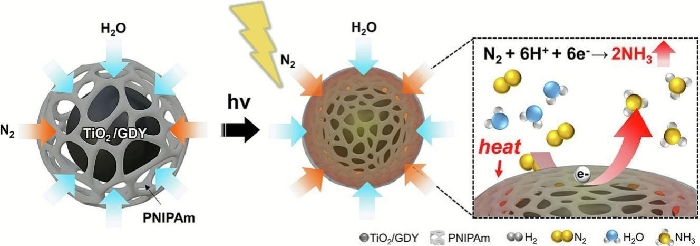
Producing NH3 via photocatalytic N2 reduction requires an ideal three-phase boundary (TPB) among N2 (gas), H2O (liquid), and a catalyst (solid). A promising strategy for developing TPB system involves photocatalyst passivation with temperature-responsive hydrogels that reversibly switch hydrophilic–hydrophobic characteristics. In this study, a self-controlling TPB system that combines a TiO2/graphdiyne photocatalyst with poly(N-isopropylacrylamide) (TiO2/GDY@PNIPAm) is explored. TiO2/GDY offers excellent solar absorption characteristics, efficient charge separation at the heterojunction, and abundant active sites for N2 reduction. Owing to a unique photothermal effect, TiO2/GDY generates a local temperature increase (39.5 °C) under irradiation. The temperature-responsive PNIPAm, utilized as an adaptive porous framework, enables dynamic regulation of interfacial wettability and gas transport within the TPB microenvironment through its hydrophilic–hydrophobic transition, thereby promoting selective N2 transport while inhibiting H2O transport. Under solar-light irradiation, the room temperature NH3 production rate of TiO2/GDY@PNIPAm (59.5 μmol/gh) exceeds that of TiO2 (0.46 μmol/gh). These findings provide valuable insights into photocatalyst design and local environment optimization using stimuli-responsive hydrogels toward green NH3 production.
- 이전글Enhancing oxygen reduction reaction activity in ZIF-derived catalysts through thermal oxidation-induced micropore enlargement 26.05.27
- 다음글Cu-induced robust Ni2+/Ni3+ transition on amorphous Ni hydroxide-based electrocatalysts for advancing electrochemical ammonia oxidation and hydrogen evolution 25.12.26
댓글목록
등록된 댓글이 없습니다.