2025 Cu-induced robust Ni2+/Ni3+ transition on amorphous Ni hydroxide-based electrocatalysts for advancing electrochemical ammonia oxidation and hydrogen evolution
페이지 정보
작성자 최고관리자 작성일 25-12-26 17:41본문
- Journal
- Applied Surface Science Advances 30 (2025) 100908
- Year
- 2025
- Link
-
- https://doi.org/10.1016/j.apsadv.2025.100908
442회 연결 - https://doi.org/10.1016/j.apsadv.2025.100908
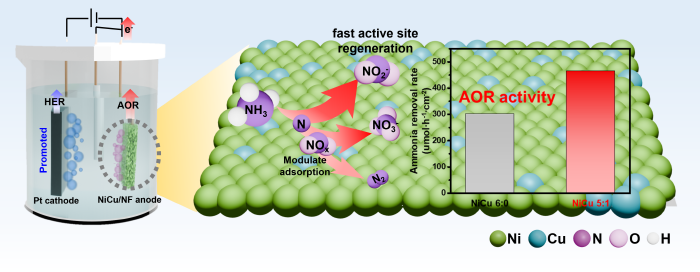
The electrochemical ammonia oxidation reaction (AOR) is a promising anodic reaction for hydrogen production, offering a lower theoretical potential compared to oxygen evolution reaction. Despite this thermodynamic advantage, AOR suffers from sluggish multi-electron transfer reaction kinetics and the regeneration of catalytically active Ni3+ species, which limits both activity and durability. In this study, amorphous NiCu bimetallic catalysts were prepared via facile precipitating metal nitrate deposition (PMND) method. The addition of Cu induces a robust Ni2+/Ni3+ transition, stabilizing catalytically active Ni3+ species and modulating the electronic structure of Ni. It alters the oxidation and desorption behavior of nitrogen-containing intermediates and facilitating their conversions to NOx species, resulting in fast active site regeneration. Furthermore, amorphous structure provides abundant dangling bonds, which enhances the intrinsic reactivity and accessibility of active sites rather than increasing the number of active sites. As a result, these effects accelerate the overall reaction kinetics. The optimized NiCu 5:1 catalyst achieved an ammonia removal efficiency of ∼100 % and a hydrogen production rate of 2.45 mmol/(h∙cm2) at 1.6 VRHE.
- 이전글Dynamic control of the three-phase boundary in hydrogel assisted TiO₂-Graphdiyne photocatalysts for Ammonia production 26.01.23
- 다음글Oxygen-terminated Ti3C2Tx MXene via electrophoretic functionalization for electrochemical nitrate reduction to ammonia 25.12.26
댓글목록
등록된 댓글이 없습니다.