2023 Perspective on the interfacial engineering for electrocatalytic N2 to NH3 conversion from catalysts to systems
페이지 정보
작성자 최고관리자 작성일 25-05-14 21:58본문
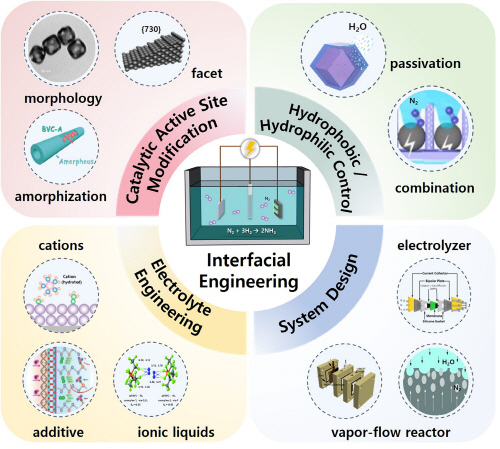
Ammonia (NH3) has received significant attention due to its increasing demand as a key commodity for industrial chemical production, a green fuel, and a hydrogen (H2) carrier. Electrochemical nitrogen (N2) reduction reaction (ENRR) emerges as the most attractive pathway to produce NH3. The process utilizes H2O as a proton source under mild temperature and pressure, which can reduce CO2 emissions and energy input compared to the traditional Haber-Bosch process. However, ENRR is severely insufficient for practical applications due to its kinetically sluggish steps compared to its competitive hydrogen evolution reaction. Also, the imbalanced reactant concentrations of N2 and H2O, resulting from the low N2 solubility, and oppositely, free H2O accessibility toward catalysts, cause the ineffective three-phase-boundary that acts as active sites for ENRR. To overcome these challenges, it is essential to perform interfacial engineering for each part of the catalyst and reaction environment. In this perspective, recent advances in interfacial engineering are examined and critically reviewed, and further research directions are proposed to develop ENRR significantly. The sections cover catalytic active site modification, hydrophobic/hydrophilic control, electrolyte engineering, and system design. The insights and prospects in this perspective will be effective for developing ENRR in a scientific and practical manner.
- 이전글Exploring the source of ammonia generation in electrochemical nitrogen reduction using niobium nitride 25.05.14
- 다음글Development of Highly stable and active intermetallic Pt-alloyed catalysts for the production of V3.5+ electrolyte in the vanadium redox flow batteries 25.05.14
댓글목록
등록된 댓글이 없습니다.