2023 Ligand-Exchange-Assisted Layer-by-Layer Assembly of Au-Pt Bimetallic Nanocoposite Films and Their Electrocatalytic Activites for Hydrogen Evolution Reaction
페이지 정보
작성자 최고관리자 작성일 25-05-14 21:53본문
- Journal
- ACS Appl. Energy Mater. 2023,6, 21, 10961-10969
- Year
- 2023
- Link
-
- https://doi.org/10.1021/acsaem.3c01739
612회 연결 - https://doi.org/10.1021/acsaem.3c01739
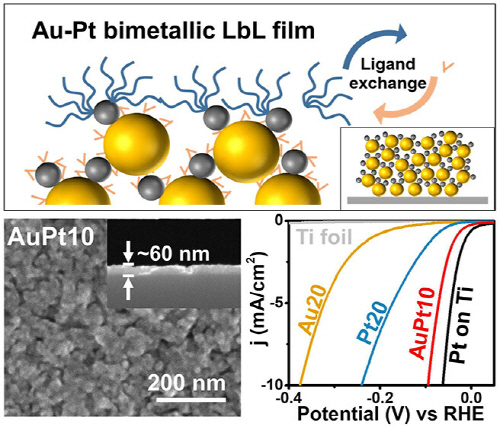
Platinum (Pt) is a popular electrocatalyst for the hydrogen evolution reaction (HER) for water splitting. However, a facile synthesis route with improved activity and stability remains to be established. In this study, Au–Pt bimetallic nanocomposite electrodes for the HER are prepared by ligand-exchange-assisted layer-by-layer (LbL) self-assembly methods. Pt and Au nanoparticles (NPs) are alternately deposited onto Ti electrodes paired with short alkyl amines. This process is accompanied by the removal of the preattached bulky surface ligands. The resulting Pt and Au NP LbL nanocomposite films are characterized by uniform thin-film depositions with high electrical conductivity (8.7 × 10⁴ S cm–1). With the increase in the number of depositions, the overpotentials of the Au–Pt LbL samples gradually decrease and reach 66 mV at a current density of 10 mA cm–2 under an acidic condition of 0.5 M H2SO4, which is accomplished with a significantly small Pt loading (0.73 wt %). Furthermore, the overpotentials of the Au–Pt bimetallic LbL films are one-third of the Pt NP LbL films. The enhanced activity can be attributed to the synergistic effect of the d-band shift from the bimetallic heterostructure, high electrical conductivity, rapid charge transfer, and increased electrochemical surface area.
- 이전글Development of Highly stable and active intermetallic Pt-alloyed catalysts for the production of V3.5+ electrolyte in the vanadium redox flow batteries 25.05.14
- 다음글Enhancing ammonia production rates from electrochemical nitrogen reduction by engineering three-phase boundary with phosphorus-activated Cu catalysts 25.05.14
댓글목록
등록된 댓글이 없습니다.