2023 Enhancing ammonia production rates from electrochemical nitrogen reduction by engineering three-phase boundary with phosphorus-activated Cu catalysts
페이지 정보
작성자 최고관리자 작성일 25-05-14 21:52본문
- Journal
- Journal of Energy Chemistry (2023)
- Year
- 2023
- Link
-
- https://doi.org/10.1016/j.jechem.2023.05.047
238회 연결 - https://doi.org/10.1016/j.jechem.2023.05.047
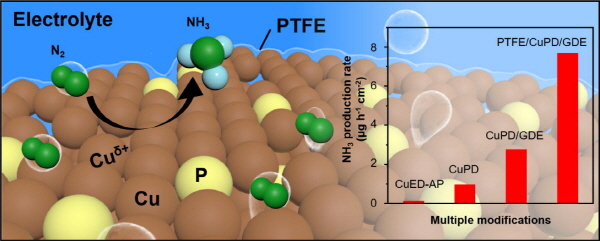
Electrochemical N2 reduction reaction (eNRR) over Cu-based catalysts suffers from an intrinsically low activity of Cu for activation of stable N2 molecules and the limited supply of N2 to the catalyst due to its low solubility in aqueous electrolytes. Herein, we propose phosphorus-activated Cu electrocatalysts to generate electron-deficient Cu sites on the catalyst surface to promote the adsorption of N2 molecules. The eNRR system is further modified using a gas diffusion electrode (GDE) coated with polytetrafluoroethylene (PTFE) to form an effective three-phase boundary of liquid water - gas N2 - solid catalyst to facilitate easy access of N2 to the catalytic sites. As a result, the new catalyst in the flow-type cell records a Faradaic efficiency of 13.15% and an NH3 production rate of 7.69 μg h−1 cm−2 at −0.2 VRHE, which represent 3.56 and 59.2 times increases from those obtained with a pristine Cu electrode in a typical electrolytic cell. This work represents a successful demonstration of dual modification strategies; catalyst modification and N2 supplying system engineering, and the results would provide a useful platform for further developments of electrocatalysts and reaction systems.
- 이전글Ligand-Exchange-Assisted Layer-by-Layer Assembly of Au-Pt Bimetallic Nanocoposite Films and Their Electrocatalytic Activites for Hydrogen Evolution Reaction 25.05.14
- 다음글Recent Advances in Electrocatalysts for Ammonia Oxidation Reaction 25.05.14
댓글목록
등록된 댓글이 없습니다.