2023 Boosting solar-driven N2 to NH3 conversion using defect engineered TiO2/CuO heterojunction photocatalyst
페이지 정보
작성자 최고관리자 작성일 25-05-14 21:29본문
- Journal
- Applied Surface Science 620 156812 (2023)
- Year
- 2023
- Link
-
- https://doi.org/10.1016/j.apsusc.2023.156812
276회 연결 - https://doi.org/10.1016/j.apsusc.2023.156812
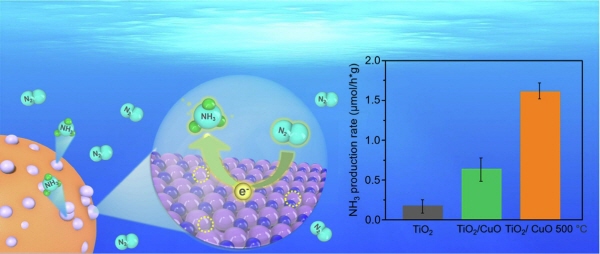
Ammonia (NH3) is one of the important energy sources for sustainable chemical products and carbon-free energy carriers. Artificial N2 photofixation is one of the promising approaches for the clean production of NH3 using photocatalysts in N2-dissolved water as a hydrogen source. We prepared defect-engineered TiO2/CuO heterojunction photocatalysts by the simple evaporation-induced self-assembly (EISA) method followed by post-thermal annealing under inert gas flow. The formation of a type-Ⅱ using TiO2 and CuO facilitated light absorption in near IR to UV light and the separation of photoexcited electron-hole pairs. In addition, the further post-thermal annealing under N2 gas flow resulted not only in an increase in crystallinity for the photoactive Anatase TiO2 and Tenorite CuO in the bulk but also in the in-situ formation of Ti3+ defect sites on the TiO2 surface. The increased crystallinity enhanced the photoexcited charge transport, while the defect sites improved N2 adsorption and activation, promoting the photocatalytic conversion of N2 to NH3. The defect-engineered TiO2/CuO photocatalysts exhibited a high NH3 production rate (1.575 μmol g−1h−1) under visible light irradiation (λ≧ 420 nm) without any sacrificial agent, this value is 9.4 times and 2.5 times higher than those obtained with pristine TiO2 and TiO2/CuO photocatalysts, respectively. This work clearly demonstrates the synergistic effect of heterojunction and defect-engineering and provides insights into how each strategy can affect solar-driven NH3 production.
- 이전글A Reviews of Transition Metal Nitride-Based Catalysts for Electrochemical Nitrogen Reduction to Ammonia 25.05.14
- 다음글Recent Advances in Electrochemical, Photochemical and Photoelectrochemical Reduction of CO2 to C2+ Products 25.05.14
댓글목록
등록된 댓글이 없습니다.