2022 Three Phase Boundary Engineering Using Hydrophilic-Hydrophobic Poly(N-isopropylacrylamide) with Oxygen-Vacant TiO2 Photocatalysts for Photocatalytic N2 Reduction
페이지 정보
작성자 최고관리자 작성일 25-05-14 20:40본문
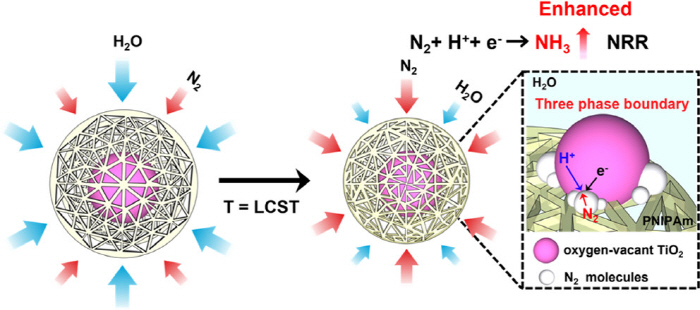
The photocatalytic N2 reduction reaction (PNRR) is a promising route for producing NH3 using renewable energy resources under ambient conditions. However, the performance of PNRR is low for practical applications due to two main challenges: the ineffective adsorption and activation of the inert N2 molecules on catalysts and inefficient formation of three phase boundary (TPB) of N2 (gas), H2O (liquid), and catalyst (solid). Herein, an advanced TPB-engineered PNRR system was designed using oxygen-vacant TiO2 photocatalysts embedded in poly(N-isopropylacrylamide) (PNIPAm). The oxygen vacancies in the TiO2 lattice generated Ti3+ species, which functioned as active sites. The physicochemical properties of PNIPAm including porosity and hydrophilic–hydrophobic nature are changed upon environmental temperature, and thus the relative concentration of N2 and H2O around oxygen-vacant TiO2 photocatalysts can be adjusted to have efficient TPB for the PNRR. Furthermore, the oxygen-vacant TiO2 with PNIPAm exhibited a significantly high NH3 production rate (11.12 μmol g–1 h–1) at the lower critical solution temperature (LCST; 32 °C), which decreased with a change in the LCST. This study is the first attempt at combining defect engineering of TiO2 photocatalysts and TPB engineering using a thermo-responsive polymeric hydrogel for effective PNRRs. The experimental results and discussion contained in this study can develop to design efficient photocatalysts for the PNRRs.
- 이전글Recent Advances in Electrochemical Nitrogen Reduction Reaction to Ammonia from the Catalyst to the System 25.05.14
- 다음글Solar-Driven Syngas Production Using Al-Doped ZnTe Nanorod Photocathodes 25.05.14
댓글목록
등록된 댓글이 없습니다.