2014~2019 Hybrid Microwave Annealing for Fabrication of More efficient Semiconductor Photoanodes for Solar Water Splitting
페이지 정보
작성자 최고관리자 작성일 25-05-14 17:09본문
- Journal
- ACS Sustainable Chem. Eng. 7, 1, 944–949 (2019)
- Year
- 2014~2019
- Link
-
- https://doi.org/10.1021/acssuschemeng.8b04562
636회 연결 - https://doi.org/10.1021/acssuschemeng.8b04562
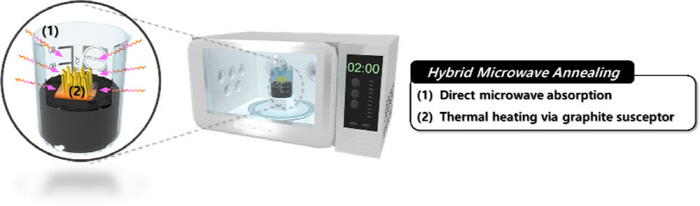
Hybrid microwave annealing (HMA) is proposed as an alternative to conventional thermal annealing (CTA) in a furnace to fabricate efficient semiconductor photoelectrodes for solar water splitting. Thus, the effects of HMA are investigated in comparison with CTA using spinel zinc ferrite as an example. The ZnFe2O4 photoanodes fabricated by HMA with a graphite susceptor provide less defective surface, better structural ordering and smaller feature size than photoanodes prepared by CTA. Besides, HMA does not impair conductivity of the F:SnO2 glass substrate. All these positive factors of HMA leads to ∼4 times higher photocurrents at 1.23 VRHE and lowered onset potential by ∼100 mV under 1 sun irradiation of an optimized ZnFe2O4 photoanode relative to that fabricated by CTA. The HMA could be an effective generic method to fabricate efficient photoelectrodes based on refractory semiconductors replacing incumbent CTA.
- 이전글Band Gap Narrowing of Zinc Orthogermanate by Dimensional and Defect Modification 25.05.14
- 다음글Photoelectrochemical Water Splitting with p-Type Metal Oxide Semiconductor Photocathodes 25.05.14
댓글목록
등록된 댓글이 없습니다.