2014~2019 A Multitude of Modifications Strategy of ZnFe2O4 Nanorod Photoanodes for Enhanced Photoelectrochemical Water Splitting Activity
페이지 정보
작성자 최고관리자 작성일 25-05-14 17:05본문
- Journal
- J.Mater.Chem A, 6, 12693-12700 (2018)
- Year
- 2014~2019
- Link
-
- https://doi.org/10.1039/C8TA02161A
247회 연결 - https://doi.org/10.1039/C8TA02161A
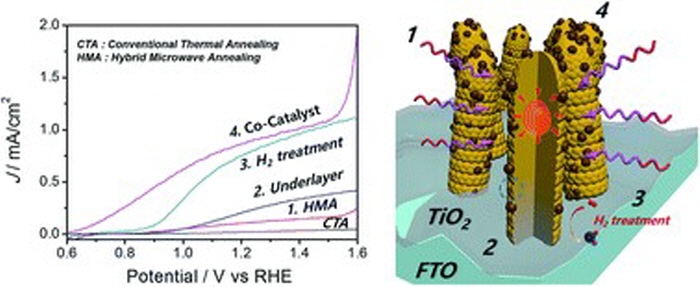
Numerous modifications strategies are applied to spinel ZnFe2O4 nanorods with a band gap energy of ∼2.0 eV to enhance their activity as a photoanode for photoelectrochemical (PEC) water splitting. First, hybrid microwave annealing (HMA) imparts high crystallinity to ZnFe2O4 nanorods, while preserving the formed nanostructure and maintaining high electric conductivity of F:SnO2 (FTO) substrate. This is in contrast to conventional thermal annealing (CTA) at 800 °C that causes aggregation of ZnFe2O4 and degradation of FTO. Second, insertion of a TiO2 underlayer blocks charge recombination at the FTO/electrolyte interface and serves as a source of Ti doping. Third, hydrogen treatment yields oxygen vacancies that increase charge carrier density and cause surface passivation. Last, a NiFeOx co-catalyst promotes hole injection into the electrolyte to improve catalytic water oxidation activity. These synergistic modifications lead to enhanced photocurrent density from 0.025 mA cm−2 at 1.23 VRHE for pristine ZnFe2O4 nanorods prepared by CTA to 0.92 mA cm−2 for a fully modified HMA photoanode: a 37-fold increase in photocurrent density. There is also a cathodic shift of the onset potential down to 0.62 VRHE. The multiple modifications enhance bulk charge separation efficiencies from mere 2% to 30% and surface charge separation efficiency from 40% to 80%.
- 이전글Exfoliated NiFe Layered Double Hydroxide Cocatalyst for Enhanced Photelectrochemical Water Oxidation with Hematite Photoanode 25.05.14
- 다음글Highly Loaded PbS/Mn-Doped CdS Quantum Dots for Dual Application in Solar-to-Electrical and Solar-to-Chemical Energy Conversion 25.05.14
댓글목록
등록된 댓글이 없습니다.