2014~2019 Carbon Dioxide Fischer-Tropsch Synthesis: A New Path to Carbon-Neutral Fuels
페이지 정보
작성자 최고관리자 작성일 25-05-14 16:58본문
- Journal
- Appl. Catal. B: Environmental, 202, 605-610 (2017)
- Year
- 2014~2019
- Link
-
- https://doi.org/10.1016/j.apcatb.2016.09.072
453회 연결 - https://doi.org/10.1016/j.apcatb.2016.09.072
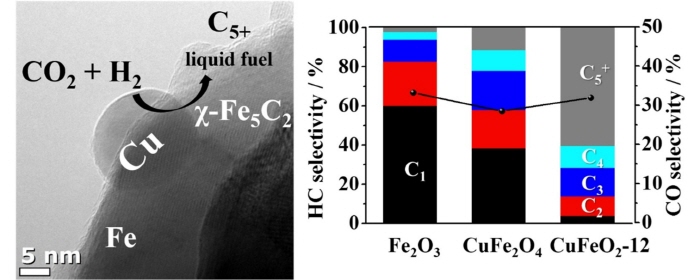
Paradigm of climate change mitigation technologies is shifting from carbon capture and storage (CCS) to carbon capture and utilization (CCU). Here we propose a new path to CCU – direct CO2 conversion to liquid transportation fuels by reacting with renewable hydrogen produced by solar water splitting. The highly promising and CO2-neutral CCU system is possible by our discovery of a new catalyst that produces liquid hydrocarbon (C5+) selectivity of ∼65% and greatly suppressed CH4 formation to 2–3%, which represents an unprecedented selectivity pattern for direct catalytic CO2 hydrogenation and is very similar to that of conventional CO-based Fischer-Tropsch (FT) synthesis. The catalyst was prepared by reduction of delafossite-CuFeO2 and in-situ carburization to Hägg carbide (χ-Fe5C2), the active phase for heavy hydrocarbon formation. The reference catalysts derived from bare Fe2O3, CuO-Fe2O3 mixture, and spinel CuFe2O4 are much less active and produce mainly light hydrocarbons, highlighting the critical role of delafossite-CuFeO2 as the catalyst precursor. The new catalyst breaks through the limitation of CO2-based FT synthesis and will open the avenue for new opportunity for carbon recycling into valuable liquid fuels at the similar conditions to industrially practiced CO-FT synthesis.
- 이전글One-Dimensional CuIn Alloy Nanowires as a Robust and Efficient Electrocatalyst for Selective CO2-to-CO Conversion 25.05.14
- 다음글2D Materials-Based Photoelectrochemical Cells: Combination of Transition Metal Dichalcogenides and Reduced Graphene Oxide for Efficient Charge Transfer 25.05.14
댓글목록
등록된 댓글이 없습니다.