2014~2019 Solar Hydrogen Production from Zinc Telluride Photocathode Modified with Carbon and Molybdenum Sulfide
페이지 정보
작성자 최고관리자 작성일 25-05-14 16:39본문
- Journal
- ACS Appl.Mater.Interfaces, 8, 7748-7755 (2016)
- Year
- 2014~2019
- Link
-
- https://doi.org/10.1021/acsami.5b07575
637회 연결 - https://doi.org/10.1021/acsami.5b07575
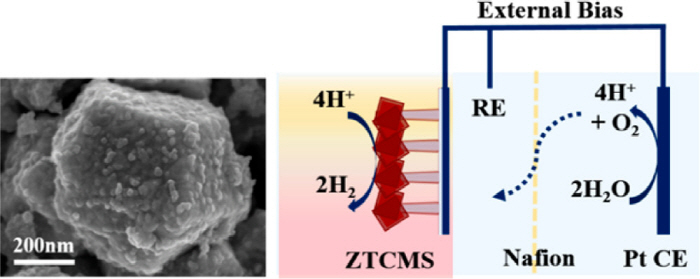
A zinc telluride (ZnTe) film modified with MoS2 and carbon has been studied as a new photocathode for solar hydrogen production from photoelectrochemical (PEC) water splitting. The modification enhances PEC activity and stability of the photocathode. Thus, the MoS2/C/ZnTe/ZnO electrode exhibits highly improved activity of −1.48 mA cm–2 at 0 VRHE with a positively shifted onset potential up to 0.3 VRHE relative to bare ZnO/ZnTe electrode (−0.19 mA cm–2, 0.18 VRHE) under the simulated 1 sun illumination. This represents the highest value ever reported for ZnTe-based electrodes in PEC water splitting. The carbon densely covers the surface of ZnTe to protect it against photocorrosion in aqueous electrolyte and improves charge separation. In addition, MoS2 further enhances the PEC performance as a hydrogen evolution co-catalyst.
- 이전글Two-Dimensional Metal-Dielectric Hybrid-Structured Film with Titanium Oxide for Enhanced Visible Light Absorption and Photo-Catalytic Application 25.05.14
- 다음글Unbiased Sunlight-Driven Artificial Photosynthesis of Carbon Monoxide from CO2 Using a ZnTe-Based Photocathode and a Perovskite Solar Cell in Tandem 25.05.14
댓글목록
등록된 댓글이 없습니다.