2020 Enabling Electrochemical N2 Reduction to NH3 in the Low Overpotential Region using Non-Noble Metal Bi Electrodes via Surface Composition Modification
페이지 정보
작성자 최고관리자 작성일 25-05-14 20:16본문
- Journal
- J. Mater. Chem. A, 8, 13842-13851 (2020)
- Year
- 2020
- Link
-
- https://doi.org/10.1039/D0TA02550J
366회 연결 - https://doi.org/10.1039/D0TA02550J
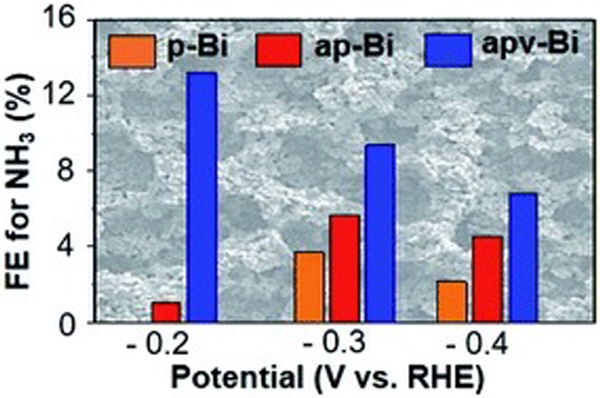
The electrochemical N2 reduction reaction (ENRR) that can produce NH3 using water as the hydrogen source at ambient temperature and pressure can be an exciting alternative to the Haber–Bosch process. The major challenge for electrochemical NH3 production is the competing hydrogen evolution reaction (HER), which seriously limits the faradaic efficiency (FE) for NH3 production. To date, noble metal electrocatalysts that are inactive for the HER have mainly been investigated for the ENRR. Studies reporting a FE greater than 10% for NH3 production using non-noble metal catalysts in the low overpotential region (E ≤ 0.2 V vs. RHE) are very rare. This study reports effective electrochemical surface modification strategies that drastically increase the ENRR activity of a non-noble Bi electrode in the low overpotential region and achieve a FE for NH3 production as high as 13.2% at −0.2 V vs. RHE in pH 7.5 phosphate buffer. The effect of each of the surface modifications on the activity for the ENRR and the electrode stability during the ENRR were systematically elucidated, which may be used to develop general strategies to enhance the ENRR activities of other non-noble metal electrodes in the low overpotential region.
- 이전글Rational Design of Photocatalyst for Ammonia Production from Water and Nitrogen Gas 25.05.14
- 다음글Photoelectrochemical Nitrogen Reduction to Ammonia on Cupric and Cuprous Oxide Photocathodes 25.05.14
댓글목록
등록된 댓글이 없습니다.