2026 Recent progress in the electrochemical CO2 reduction reaction on MOF- and COF-based catalysts
페이지 정보
작성자 최고관리자 작성일 26-06-22 10:53본문
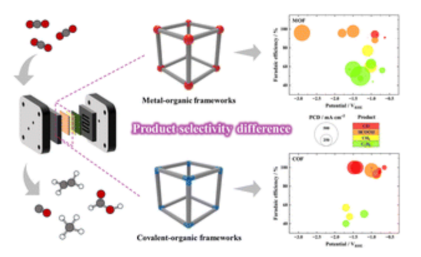
Growing global energy demand continues to drive fossil-fuel-derived carbon dioxide (CO2) emissions. Electrochemical CO2 reduction (eCO2R) has attracted attention as a carbon cycle technology owing to its ability to operate under ambient conditions and use renewable electricity directly. The high thermodynamic stability of CO2, competition with the hydrogen evolution reaction, and low product selectivity can be overcome with careful catalyst design. Metal–organic frameworks (MOFs) and covalent organic frameworks (COFs) offer porous structures and tunable metal active sites, enabling simultaneous control over CO2 adsorption/activation, intermediate stabilization, and product desorption. Therefore, they hold promise as eCO2R catalyst platforms. This paper summarizes the fundamental aspects of eCO2R and then compares the product selectivity on MOF- and COF-based catalysts. On this basis, this study analyzed key design parameters, including the metal core composition, ligand electronics, and framework reconstruction, and developed guidelines for selecting an appropriate framework when a specific product is targeted. This review is expected to serve as a guide for the rational design of next-generation eCO2R catalysts.
- 이전글Spin polarized oxygen evolution reaction in chiral amorphous manganese-doped cobalt oxide: enhancing electrocatalytic activity via lattice oxygen participation 26.06.22
- 다음글Bias-free, high-rate solar hydrogen production in alkaline media with a NiCo-coupled perovskite photocathode 26.05.27
댓글목록
등록된 댓글이 없습니다.