2024 Comparative study on the photoelectrochemical hydrogen production from the layout optimization in a unit cell
페이지 정보
작성자 최고관리자 작성일 25-05-16 18:20본문
- Journal
- ACS Appl. Electron. Mater. 2025, 7, 1, 331–339
- Year
- 2024
- Link
-
- https://doi.org/10.1021/acsaelm.4c01817
712회 연결 - https://doi.org/10.1021/acsaelm.4c01817
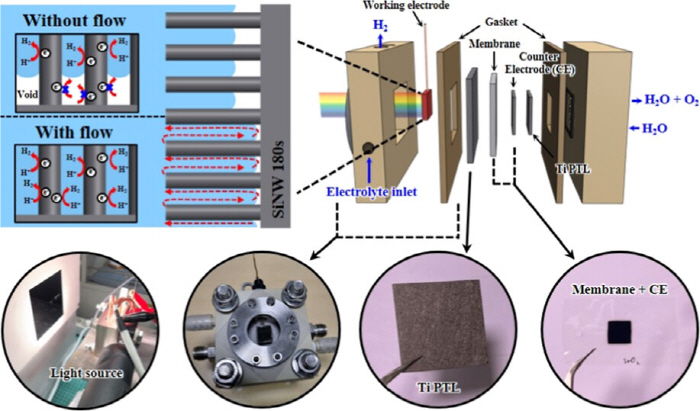
Solar-driven water splitting is achieved by connecting photovoltaics with electrolysis. Recently, integrated approaches of the two configurations for photoelectrochemical reactions have shown great potential in a combined unit, but strategies to address further material and cell development face significant scientific challenges. Here we present an experimental demonstration of photoelectrochemical (PEC) unit-cells with efficient separate dual compartments for oxygen evolution and hydrogen evolution reactions. The design and fabrication of cell architectures with various degrees of integration are investigated efficient and sustainable PEC processes. The effect of the nanostructured silicon (Si) photoelectrodes, including the adoption of layer architectures, surface protection layer deposition, and membrane electrode assembly is further studied to optimize the design parameters of the PEC unit-cells. This developed PEC cell with the Si photocathode achieved a photocurrent density of −4.8 mA cm–2 at −2.0 Vcell and −2.87 mA cm–2 at −1.6 Vcell. It clearly provides a critical milestone for unbiased solar water splitting. Practical solar to hydrogen (STH) can be directly estimated in investigating PEC performance in this unit-cell as assembled with a solar cell. It is a significantly meaningful step forward in practical solar fuel production.
- 이전글Role of Ethylene Diamine Tetraacetate as an Additive in Electrolyte on Intermediate Stabilization in Electrochemical CO2 Reduction 25.05.16
- 다음글Robust dihydroxyacetone production via photoelectrochemical glycerol oxidation using an oxygen vacant BiVO4 photoanode 25.05.16
댓글목록
등록된 댓글이 없습니다.